Soul Calibur 2
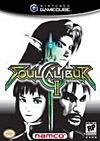
- Developer
- Namco
- Publisher
- Namco
- Genre
- Fighting
- Players
- 1-2
- Rated
- Teen
- Released
- 8/27/2003
"Sould Callibur 2 is the best fighter for GameCube and among the greatest on any console."
When Soul Calibur was released as a launch title for the Sega Dreamcast, it was heralded as the greatest 3D-fighting game of all time. A bold statement indeed. So bold, in fact, that its sequel, Soul Calibur II, has been held against incredible standards. Anticipation this high is not always met--and SC II is nowhere near the revolution in fighters like its predecessor was. But despite all of its annoying quirks and various oddities, the game still arises as a premier title fully deserving of your time. SC II keeps the core control and gameplay entirely impact along with the technical changes that are necessary to accommodate the GC prowess.
Its safe to say that almost everyone knows that Link appears as the exclusive character on GC. The green-clad hero comes packed with a heavy arsenal, from the legendary Master Sword to the traditional boomerang, bombs, and arrows. He actually fits right in with the rest of the cast and is a very powerful fighter. In total, there are around 15 combatants to choose from. Many of them return from Soul Calibur, with some notable new additions like Talim, Raphael, and Necrid, a new creature designed by Todd McFarlane (creator of all things Spawn). For the most part, the whole crew is balanced quite nicely and ultimately familiar, and series veterans will instantly recognize many of the same moves and animations. There are definitely a good amount of better attacks thrown into the mix, but I often found it annoying that some of the fighters felt eerily similar. Naturally, each of them have differing attributes, like better range, defense, and so on, but almost every combatant shares a plethora of reused attack combinations. While fighters do have their own specialties, I could basically pick up a character and pummel an opponent with the same strategy I had previously utilized.
As was the case with Soul Calibur, the control here is nearly flawless. The game still retains the 8-way movement, but let it be known that using the joystick didn't feel completely natural at first and the D-pad just doesn't suit the action well. However, practice makes perfect, and soon you'll be shuffling around stages with ease. Prior to SC II, many felt that the GC controller couldn't hold its own with fighters. Namco realized this and tuned the configuration accordingly--this game feels great, creating excellent playability.
Soul Calibur II's multiplayer is easily on par with anything else on the market: playing against your friends rarely gets old. The artificial intelligence is fine, but it has a nasty habit of stringing together unbelievable combos to defeat you in a matter of seconds. This holds especially true in the Weapon Master mode, a new addition specifically targetted toward either the socially-challenged or those looking for a fresh experience. In this single-player feature, gamers are subjected to a variety of events spread across ten chapters. A good majority of these challenges have restraints against you, such as defeating an adversary before your health drains. Weapon Master begins pleasantly enough, but soon you'll come to grips with the repetitive missions and overall boredom, as it eventually becomes an exercise in tedious button-mashing. There are some admittedly cool features in Weapon Master, like a host of unlockables (art galleries, characters, levels, and more) and the ability to purchase weapons and alternate costumes with gold acquired in battle. The weapons are basically only cosmetic upgrades because I could identify little to no difference in performance. As a whole, Weapon Master mode has its moments, but the lame story aspects only solidify the fact that SC II is still meant to be enjoyed with friends.
The visuals in the game are stellar. Fighters slink around with the utmost of ease, showcasing terrific animation. It helps that they look equally impressive; hair flows with movement, clothing flaps in the wind, and everything else adheres to a sexy style. Particles effects are top-notch as well, which is fortunate considering SC II is weapons-based. Environment-wise, the graphics don't suffice quite as well, but what is here certainly does the job. Many of them are just prettier versions of previous stages in the series, and while they didn't exactly blow me away in terms of aesthetics, that's excusable.
SC II's audio consists of some nice tunes and good sound effects, but it stutters with the voiceacting. Perhaps it was rough translation; or maybe the acting is mediocre. But in any case, the fighters sound pretty bad and the announcer's attempt at creating drama and tension before the battle doesn't really do the job. Luckily, I enjoyed the music, and the weapons' clashing sounded entirely believable.
Soul Calibur II shows that its predecessor was truly ahead of its time. Those who obsessed over Soul Calibur will have a hard time pinpointing any notable changes in the gameplay, and if you're planning on playing SC II alone, you may want to look elsewhere. Of course, that isn't to say SC II doesn't measure up. Basically the opposite, as the game is still the best fighter for GameCube and among the greatest on any console.